
Threading Lineage: A Conversation with the Artists
By local writer and change agent, Amy Halloran
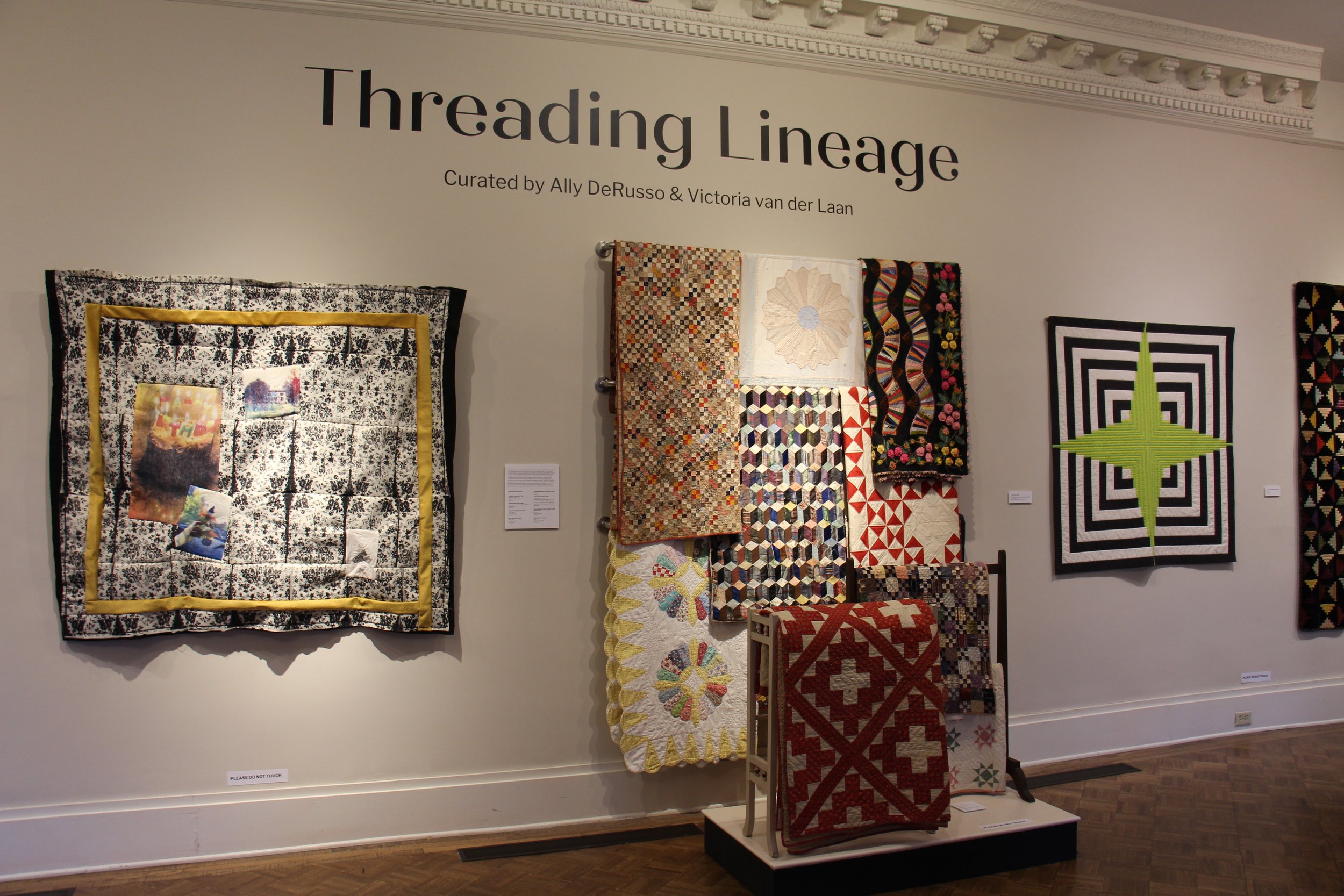
I was excited when I heard about Threading Lineage, an exhibit connecting contemporary textile artists with HCM collections. Needle arts are such strong, subtle records of women’s lives, and I couldn’t wait to see what caught the eyes of curating artists Ally DeRusso and Victoria van der Laan.
Their choices, which are presented alongside pieces of their own work, are stunning. Standing in front of the taut ruffles of a Victorian mourning bonnet, and seeing its echoes in Victoria’s work, boomerangs me from the past to now and back again. Looking at the daguerreotypes Ally chose, and seeing how they are mirrored in the prints on her quilt has the same effect. The show puts you in the midst of many visual moments.
And yet, all of these pieces existed, at HCM, and in the artists’ studios, prior to the artist/curators’ examining the collection. The patterns of handwork, color schemes, and printed portraits just needed to be noticed, and the work displayed.
What a gift that HCM invited these women to study what is available, and offer visitors a sense of the continuities that carry from the 19th century to now, threading together people, creativity, and creations.
I spoke with Ally and Victoria to learn how the show came together. Our conversation is condensed for the sake of clarity.
Amy Halloran: I'd love to hear about the curation process. Was it like being a kid in the candy shop?
Victoria van der Laan:
That’s a great way to describe it. We were able to go into the upper floors of the Hart Cluett House and two of the quilts in the exhibit were pulled from there, and the quilt stands. To see the textiles there and in the collections was an amazing opportunity.
I often talk about working within a lineage. And what I'm talking about is my own family, but it's truly a countrywide lineage that I'm working within as a quilt maker, as a textile artist, as a needle worker. Putting that concept in context so literally was really interesting for me.
Digging into the quilt collection, it was hard to decide. We didn't have infinite space to work with and quilts are large objects, so making a quilt out of quilts, a collage was an exciting solution. I wasn't even aware of the museum before being asked to do this, and I’m so glad to know of this treasure.
AH: Ally, what was your experience like?
Ally DeRusso:
I also wasn't aware of the museum prior to this, so it's exciting to know about and to have worked with them on this show and go through the collection. It was fun to go through the archives and find these little nuggets that were really interesting. I love looking at the quilts, but I also was drawn to some of their like photographic objects. I ended up pulling daguerreotype cases that had photographs of local people from the late 1800s, because those have been inspiring for my work.
I work in a quilt-like fashion, using photographic imagery within textile pieces. I find a lot of inspiration in the daguerreotype cases. They have velvet cushions that are embossed with decorative elements. One of the cases had “Troy, New York” embossed into a piece of velvet, and it was neat to see the local history and this old photo studio.
These were stored in flat file drawers, and I had to pull them out and open each one. This was my first time handling daguerreotypes because usually they're behind glass at museums and you can't touch them. So that was a cool experience, actually picking up these objects in the way that they were meant to be interacted with.
AH: Have you done some curation before?
Ally DeRusso:
I work at Saratoga Arts and I'm the exhibitions coordinator. The opportunity to work with a historical collection was really exciting to me and so different, pulling things from an archive rather than getting work from contemporary artists.
AH: How did your work on this exhibit overlap and evolve?
Victoria van der Laan:
We pulled from the collection separately, and then honestly, it just kind of came together. I don't know, Ally, if you feel the same. We brought our stuff together and it just kind of worked. I was fully prepared to make another piece if it needed to bring the show together. I think it was very serendipitous how it all fit together so well.
Ally DeRusso:
We were trying to figure out how to pare down what we pulled and then incorporating our own work. When we brought our pieces into the space and got to see them together, there were these through lines that we weren't expecting to come up.
I think it was interesting, the relationships between our own pieces and what we chose from the collections. We both had these two primarily black and white pieces that ended up being bookends to the larger collaged quilt installation that we did in the center. That was a nice balancing moment.
And I think it was interesting that you had the piece about the mourning bonnet, and then you were able to put a mourning bonnet into the show from the historic collection. These feel connected to my work, which relates to this idea of memorialization and remembrance.
These lines of connection started to appear as we discussed the work, but also like visually in terms of color and patterning and things like that.
AH: Do you think this process, or what you viewed in the collections are influencing what you're creating right now?
Victoria van der Laan:
That's a good question. All of the historic quilts in the show are hand done – hand cut out, hand pieced, hand quilted, hand bound. And that's how I learned as a child from my grandma and my great-grandma.
I don't often do hand work anymore because it's very slow. And I need to complete more than one piece a year. Getting back to those hand processes, which is my history, also the history of the craft, is something I've been thinking a lot about lately, and certainly thought about as I taught this workshop here with hand piecing.
The ruffle piece that Ally referred to, the one that references the mourning bonnet, that wasn't hand pieced, but I used like a smocking pleater, which is a piece of equipment that is from the middle of the 20th century. So using older processes to make something more modern and slowing down and doing more hand stitching is kind of where my thinking is headed, because of this show.
Ally DeRusso:
Seeing the lineage from this standpoint is curious. My personal family lineage spreads across the collective history. Textiles being really important in homemaking and family history is a universal experience. And it often is a generational process that is passed down to people, so that's been interesting to think about in terms of my own work and then in the context of craft.
I’m always inspired by fabric and its malleability and its ability to be molded into different things. Glenn Adamson wrote a book about material intelligence called Fewer Better Things, and he talks about craft as this two-way street. As you're working and shaping the material, it's shaping you right back. And I kind of love that relationship between like the fabric and you working with it, and thinking about your ancestors also having that relationship.
Before the show, I had started doing some embossing of velvet myself and I want to try and explore that more.
AH: What do you do to emboss velvet?
Ally DeRusso:
Well, so I'm primarily a printmaker and I do work in textiles, but I carve blocks, wood blocks or linocut blocks. You wet the velvet and put it pile side down onto the block and press it with a really hot iron. And the heat and the pressing makes the pile of the fibers compress and you get the design that you have carved on your block onto the fabric.
AH: That is wild. I love that.
Ally DeRusso:
It's very fun.
AH: What do you want viewers to notice or know of your experience?
Victoria van der Laan:
I think the appreciation of what's traditionally considered women's work and the work of women's hands. We don’t know many of the makers of these pieces. And they're works of art, they're masterpieces, but they're just everyday items as well. When you hold up something that is 150 years old, and look how it's held up, and look at these tiny stitches, and look how amazing this work was, and all the hours and care that these women, I think I can confidently say all women, put into this, including these contemporary women who are doing it.
I want to plug that I included one of my great-grandmother's quilts in the show, which is so special to me. I’ve always wished my grandmothers were alive to see me putting a quilt on the wall and have it be celebrated as an artwork. And to know that I'm in a show with my great-grandma is pretty cool.
Ally DeRusso:
I would echo a lot of what Victoria said in terms of appreciating these like historic quilts as their own works of art. I think they're seen in this domestic space as a functional object, which of course they are, but also, they're these gorgeous pieces of art. There’s a lot of like decision making that goes into the process, they’re thinking about the way the colors of the fabric are working together. And I think of the little postage stamp quilt that's in there that looks like it's totally like random at first glance. Then, if you look for a long period of time, you notice this pattern of these orange checkered square come up like throughout the quilt.
The amount of thought and time and intention that went into putting that quilt together, and deciding those visual moments of color and pattern and visual rest and negative space – that all goes into making the quilts.
*** If you weren’t able to see Threading Lineage in person, see the online exhibit HERE. ***