
The Conyns
The oil portraits of Leendert Philipse and Jannetje Van Alen Conyn are part of the 2026 exhibit at Hart-Cluett “The View from Here”. The artist conveniently dated the portraits to 1721, and gave the ages of the sitters, which helps to research them and the artist. They were donated to the Hart-Cluett in 1978 by descendant Miss Helen VanAlstyne Hodgkins. They had been passed down in the family.
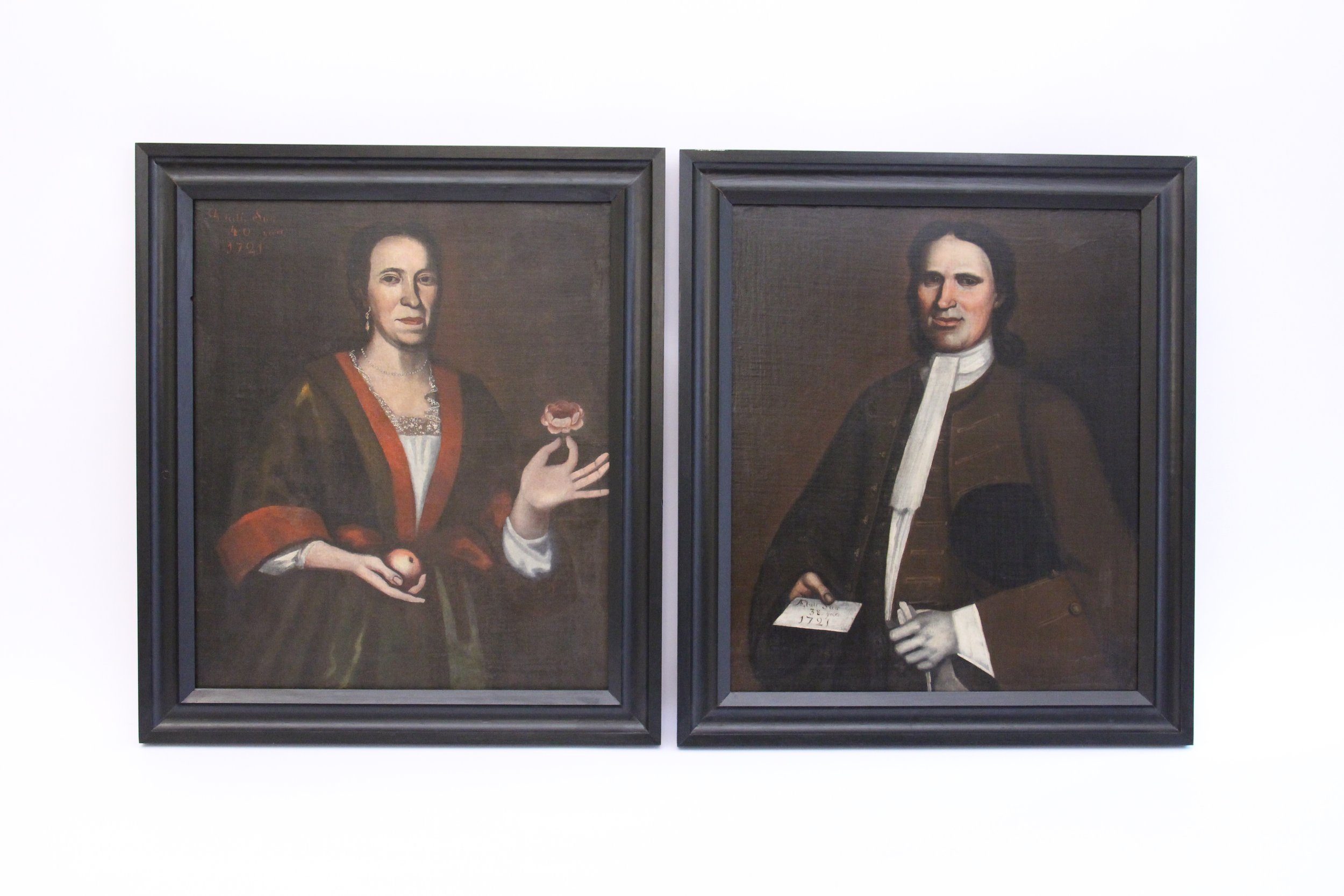
With a little more research, we know that Leendert Philipse Conyn was the son of Caspar Leendertze Conyn and his wife Alecta. He was baptized in the Albany Dutch Reformed Church in 1687. Jannetje Van Alen was the daughter of Lawrence and Elbertje Backer Van Alen. Born in 1686, she was also known as Emmetie in church records. The couple married about 1713 and had at least five children. There is a reference to them living in Kinderhook in 1720. Jannetje died in 1758 and Leendert in 1765.
We may assume from the fact that they could afford portraits of themselves that the Conyns were a well-off couple. They were very much part of a thriving 18th century Dutch society in and around Albany.
Who painted these portraits? There are many similar portraits of Albany Dutch in museums: a half dozen in the Albany Institute of History and Art, one in the Brooklyn Museum, two in the Smithsonian. As the artist labelled them all “Aetatis Suae”, he was known by that title from a number of years, a convenient way to say that the artist was unknown. The words are just Latin for “aged” or “in the year of his age”. In 1980, Mary Black, renowned art historian, published an article outlining her discovery that the paintings- at least eighty found so far- were by Nehemiah Patridge. His paintings all share the dating, using Latin “Aetatis Suae”, and use of blue, brown, black, and rust. As with the portraits of the Conyns, the figures are rather stiff, as is typical of untrained artists. And the women hold a piece of fruit or a flower. The similarities of the portraits of the Conyns to the man at the Smithsonian and the woman at the Brooklyn Museum are clear.
Patridge was born in 1683 in Portsmouth, New Hampshire, the son of William and Mary Brown Patridge. His father was the Lieutenant Governor of New Hampshire from 1696-1703. Patridge began his career as a japanner- a type of decorative painting on tinware- in Boston around 1714. He moved to New York City by 1718, listing his profession as “limner”, or portrait painter. Around then, he was introduced to the Dutch society of Albany, where there had been no painters to that time. He was successful very quickly, painting many prominent citizens. He traveled to Newport, Rhode Island and Jamestown and Williamsburg, Virginia, but was back in Albany by 1724. The last painting attributed to him is from 1725, and it is believed he died about 1729.
In the current exhibit, these paintings illustrate the strong Dutch culture of Rensselaer County, which persisted long after the English took over the colony of New York in 1664.
Black, Mary C. "Contributions Toward A History of Early Eighteenth-Century New York Portraiture: The Identification of the Aetatis Suae and Wendell Limners." The American Art Journal 12 (Autumn 1980): 4-31.
Wikipedia
Website of the Albany Institute of History and Art
“History of Cornelius Maessen VanBuren” p 256- found in ancestry.com