
Troy Pig(s) Out!
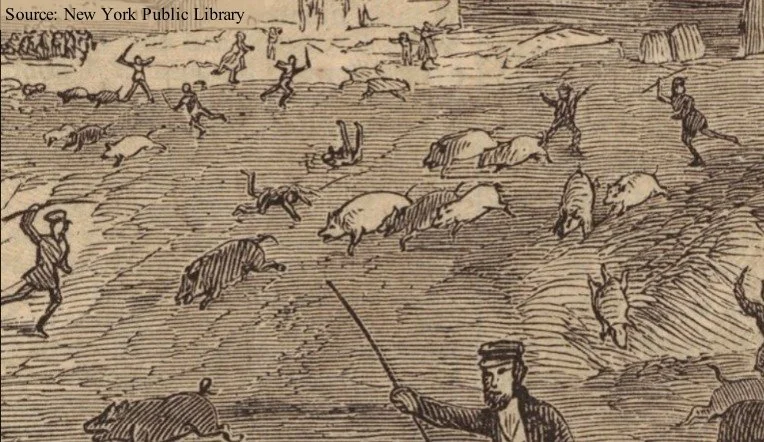
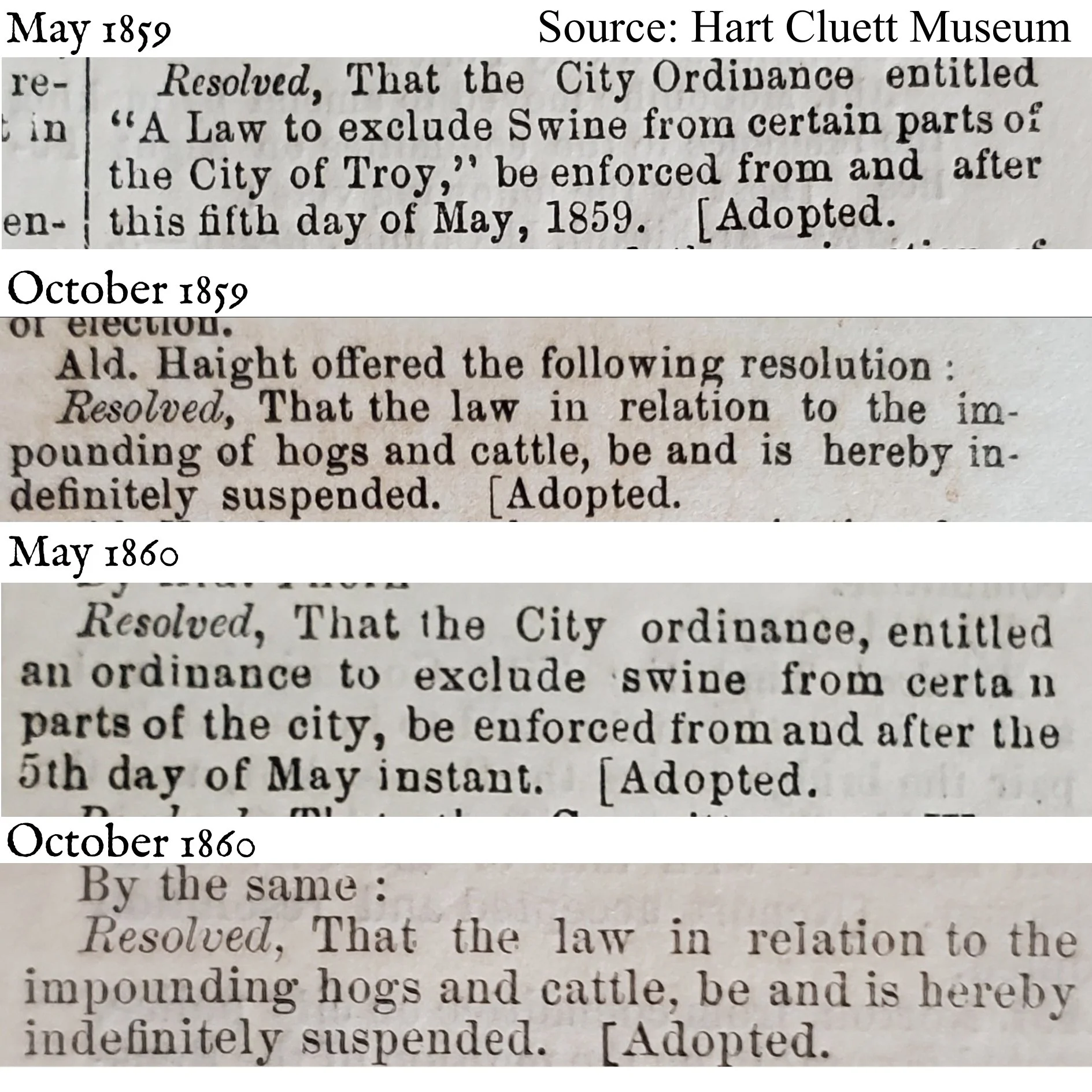
It might be hard to imagine now, but free-roaming pigs were a common sight on Troy streets for much of our city’s history. In the meeting minutes of Troy’s Common Council, we find that in between mapping the city infrastructure, dealing with joyriding firemen, and suing railroad companies for breach of contract, Troy’s local government was often concerned with laws regulating urban swine (called “hog law”), either excluding them from sections of Troy entirely or forbidding them from roaming free. The Council’s discussion of impounded swine, and the fines issued for breaking hog law, show that it was a genuine issue throughout the 19th century.
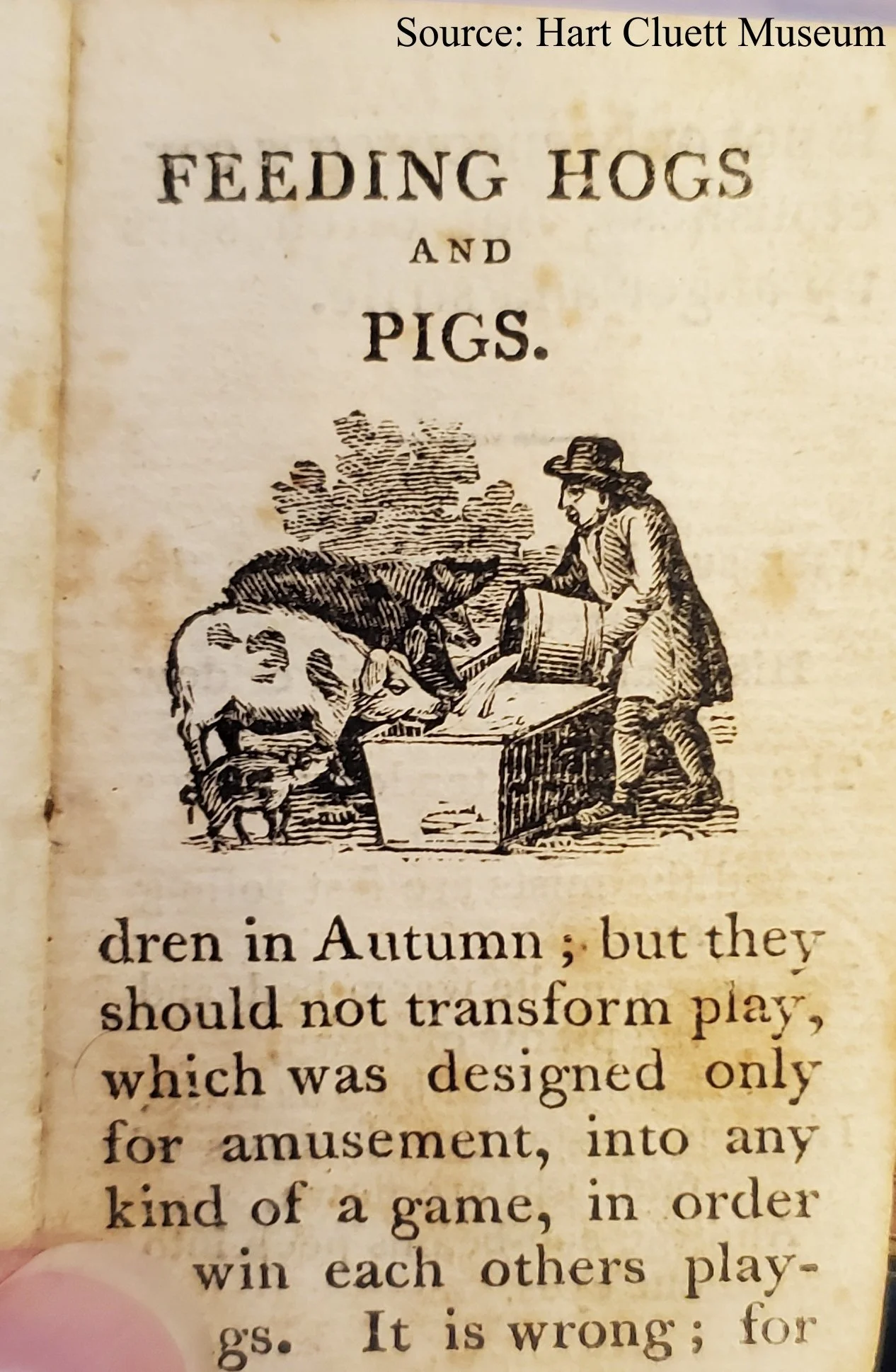
Troy’s problem pigs weren’t unique. Livestock were common in American cities until the early 1900s, and pigs were a relatively low-cost investment that “converted waste into meat” (Petersen-Rockney, 2021, p. 662). Pigs could be penned or left to wander the streets as “living and breathing filters for city refuse” (Robichaud, 2019, p. 21) until they grew fat enough to sell or slaughter. Cities benefitted from their grunting garbagemen; after a crackdown on pigs in 1859, New York City had to foot the bill for more human street cleaners (Mizelle, 2011).
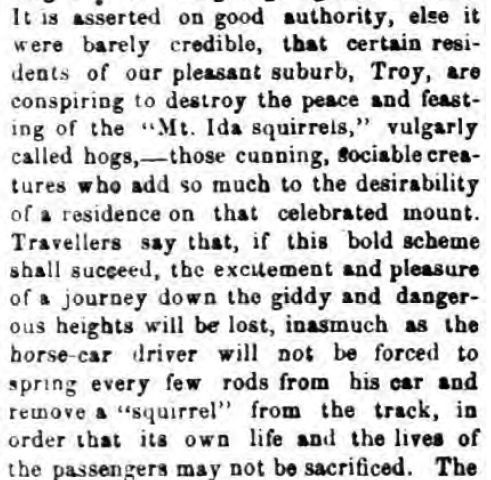
Pigs were were not, however, universally appreciated. As early as 1798, Benjamin Gorton, the Village of Troy’s President (later turned apocalypse-predicting preacher), passed an ordinance declaring that “no ſwine shall be permitted to run at large within the village of Troy.” In 1838, Troy (now a city) instituted a similar law, limiting pigs only to pens in specific wards, but neither Gorton’s ordinance nor the later law solved the issue. In 1877, an Albany newspaper claimed Troy’s pigs (which they called “Mt. Ida squirrels”) were so numerous that they made a drive down Mt. Ida potentially deadly. The Troy Daily Times responded with embarrasment: “Troy is gaining a most undesirable reputation. The grunting animals roam upon our streets at pleasure […] Swine should be confined upon the premises of their owners. The city cannot afford to offend the tastes of respectable residents and amaze and disgust visitors by the prevalence of pigs and hogs in public places” (1877). By 1893, Troy’s Board of Health had declared that pigs were allowed only in pens in parts of the fifth and sixth wards, only with an approved application, and not within 300 feet of a residence (“Rules and Regulations of the Board of Health”, 1893). Troy was clearly on a trajectory to move pigs outside the city entirely.
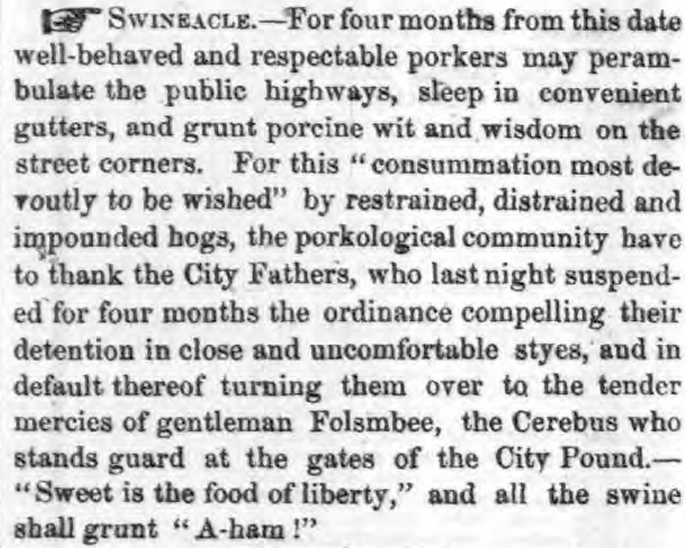
If Troy was working to restrict pigs as early as the 18th century, why was Troy beset by Mt. Ida for the next century? It seems Troy’s city governent was ambivalent about actually enforcing the law. In June of 1853, for example, the Troy Daily Times notes that special deputies had been recruited to drive more than 30 roaming pigs to the pound in a sudden enforcement of the ordinance. In early September of the same year, the Common Council suspended enforcement of hog law, and later held a vote (a tie) on a possible repeal of the law. The following April, the minutes report that the Council almost unanimously extended “the hog law on Congress St”, then in May adopted a resolution to appoint a special constable to “enforce hog law” once again (Troy Common Council Minutes).
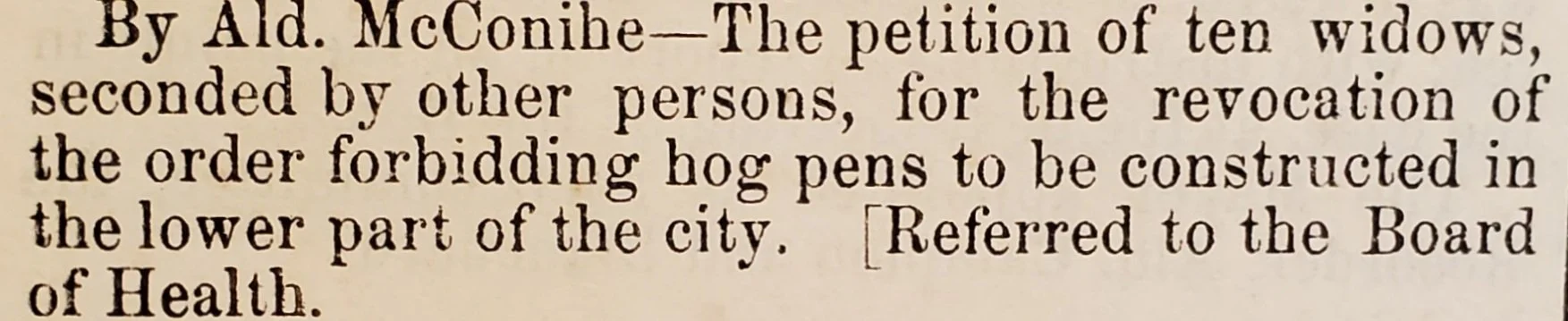
In Animal City: The Domestication of America, Andrew Robichaud writes that legislation against urban livestock was a way governments “tested the reaches of police and regulatory powers” (2019, p. 8), and the Common Council’s members likely had competing ideas about how those powers should be used. Enforce the law, and poorer residents suffered. Pigs were seen as a reliable source of food for low-income residents during the winter; the cycle of enforcement during the growing season and suspension during the fall and winter seems to be a form of unwritten seasonal reprieve. In 19th century America, some believed that any hog law incentivized persecution of poor or unliked neighbors (Mizzelle, 2011 p. 54). Hog laws, including Troy’s, often rewarded those who brought roaming pigs to the pound, and the pound-keeper sold pigs that owners failed (or couldn’t afford) to redeem. Troy citizens regularly petitioned the Council for reimbursement of pound fines, the value of an impounded pig, or repeal of the hog law entirely. In 1854, the Daily Whig wrote that Troy’s city pound was “burglariously broken open” and “nine porkers” taken. People wanted and needed their pigs.
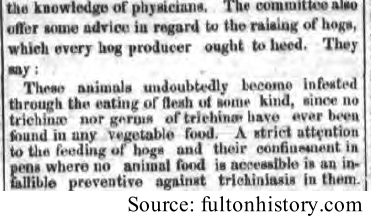
On the other hand, failure to enforce hog law opened politicians up to political attack. An 1856 column in the Daily Whig implied that mayoral candidate G. Robertson, Jr.’s lax attitudes on hog law spoke of dangerously liberal positions, writing that he was “in favor of free soil, free speech and Free Hogs, “a reference to the slogan of the anti-slavery Free Soil Party; Robertson was not elected (“Free Hogs.”, 1856). As medical science developed a greater understanding of zoonotic diseases, too, street hogs were seen as more than a nuisance. An unregulated diet of roadside trash was a possible public health issue, a vector for urban unwholsomeness to enter the food supply. Pigs and other livestock belonged in the healthier (and more distant distant) countryside, and the logistical possibilities of America’s growing rail infrastructure allowed hog-haters to argue more strongly against livestock within city limits.
As Troy’s laws grew stricter, some farmers may have simply crossed the river. In 1897, Troy’s Daily Times wrote that Watervliet’s lack of a pound had pigs “revelling in the streets” (“For a City Pound”, 1897). Even Watervliet, though, was eventually pigless. The slow process of centralizing agriculture and shaping the modern city eventually gave us today’s hog-free streets, as well as a disconnect between us and the production of our food. Still, the pigs left their mark. Long-time residents of Troy may remember the that Pigtown was the nickname of the South Troy neighborhood between Monroe St. and Canal Ave. through the 1970s, reportedly because of the pigs and other livestock once common in that area (Scanlon, 1994). The Mt. Ida squirrels aren’t yet entirely forgotten.
Blog post and research by Adam Kneeland, HCM volunteer researcher.
References
Board of the Health of the City of Troy. (1893). Rules and Regulations of the Board of Health of the City of Troy. Catholic Weekly Printing and Publishing.
“For a City Pound”. (1897). Troy Daily Times. Fultonhistory.com.
“Free Hogs”. (1865, March 4). Troy Daily Whig. Fultonhistory.com.
“Hog Law”. (1877, November 12). Albany Evening Times. Fultonhistory.com.
No title. (1877, November 18). Troy Daily Times. Fultonhistory.com
Kneeland, A. (2026). Detail from Samuel Wood’s “Autumn”. [photograph]. Rensselaer County Historical Society.
The Miriam and Ira D. Wallach Division of Art, Prints and Photographs: Picture Collection, The New York Public Library. (1859). Driving the captured pigs to the pound: Scene of great confusion and riot Retrieved from https://digitalcollections.nypl.org/items/40b5c1f0-c559-012f-8b84-58d385a7bc34
Mizelle, B. (2011). Pig (1st ed.). Reaktion Books.
Petersen-Rockney, M. (2021). Porcine Providence: Pigs, Space, and Cultural Strategies of Exclusion in the Making of a US City. Agricultural History, 95(4), 659–689. https://doi.org/10.3098/AH.2021.095.4.659
Robichaud, A. A. (2019). Animal city : the domestication of America. Harvard University Press. https://doi.org/10.4159/9780674243187
Scanlon, J. (1994, March 10). ‘Pigtown Remembered’. Troy Record.
“Swineacle”. (1857, November 6). Troy Daily Times. Fultonhistory.com
“Trichinae – Important Discoveries”. (1866, April 17). Troy Daily Whig. Fultonhistory.com
Troy Common Council Minutes, Rensselaer County Historical Society.